Kiwacht-Edge + SLMs
Sovereign AI with a small footprint for European Businesses

Large AI tools extract intelligence from your business interactions by default, and outside EU jurisdiction.
Kiwacht-Edge offers workflows for Small Language Models (SLMs) so that developers can build custom, offline tools for businesses.
Sovereign AI for Europe
Big Tech builds foundries that are centralised and extractive.
We can help you build campfires that are faster, local and sovereign.
Kiwacht Edge runs 100% offline.
Your rules. Your control.
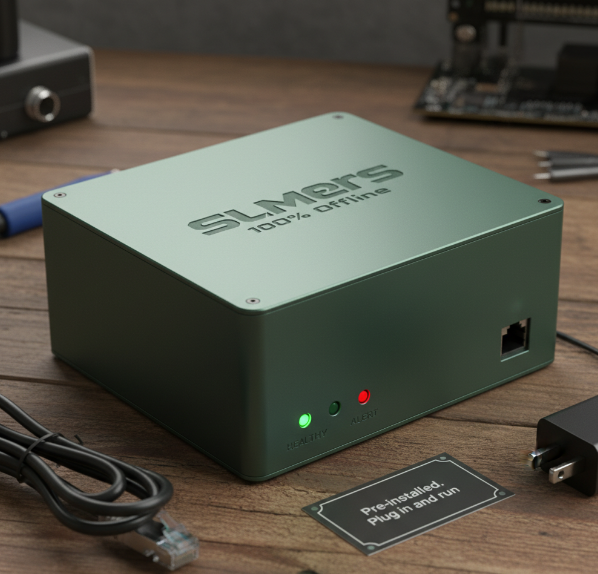
SLMers: Sovereign AI appliance running Kiwacht-Edge

The SLMers appliance (pronounced slammers)
Kiwacht-Edge running on a €500 mini PC.
What’s inside the SLMers box?
• Mini PC (AMD Ryzen 5, 16GB RAM, 512GB SSD)
• Pre-loaded with Kiwacht-Edge Docker image
• Printed quick-start guide (no cloud setup)
What is an SLM?

A Small Language Model (SLM) is a lightweight AI, typically under 4 billion parameters, far smaller than LLMs (large language models) like OpenAI’s GPT (175B+).

SLMs use a fraction of the energy, they can run on a standard office PC or even mobile phones, while LLMs require massive data centers.

On its own, an SLM can already summarise, translate, or assist with code, but with platforms like Kiwacht-Edge, an SLM powers real-world business workflows - voice alerts in retail, invoice validation for accountants, DVSA form automation, or license-compliant asset handling in creative agencies.

The future of AI isn’t bigger models, it’s smaller, faster, sovereign, independent intelligence which runs offline, respects GDPR, and stays under your control.

Why It Matters for Europe

Europe cannot compete in the AI race between the US and China by building bigger models. Europe must choose a third path, being sovereign, sustainable, and guided by humans (EU AI Act).

It is not a question of whether artificial intelligence will transform the world, this is already happening. The real question is, who will shape the transformation? Billionaire CEOs? Nation states? China or the US?

The main winners of an AI-driven economy will not be workers or consumers, but the owners of models, data, and computational infrastructure. Europe must not become a data colony in this new world order.

The owners of superintelligence like OpenAI, Gemini could declare that your data is kept private, yet affect your life negatively by aggregating the financial decisions you make on the stock market.

Kiwacht-Edge keeps intelligence in your office.

What Can Kiwacht-Edge Do?

Microsoft is document-centric, Apple is app-centric and Kiwacht-Edge is workflow-centric. We encourage local programmers or business owners to build custom SLM solutions by writing rules.json by hand using KiWacht-Edge. JSON is our workflow engine.
Typical agentic models use JSON as a machine-to-machine protocol. We use JSON because it’s transparent, editable, and universal. Anyone, either the developer or the business owner can open rules.json and see exactly what the system will do.

Neuro-symbolic AI is a hybrid AI approach and is considered a "third wave" of AI.

  • KiWacht Edge implements some principles of Neuro-symbolic AI.
  • Neuro-symbolic AI bridges two worlds, neural networks and symbolic systems (in our case rules.json).
  • Kiwacht-Edge brings this idea to life like this: your team writes explicit rules in rules.json (the symbolic layer) A small language model (like Phi-3, Qwen, LLMs4Europe) interprets messy input (the neural layer)
  • The system suggests actions and you decide

This isn’t theoretical AI. It’s sovereign, auditable, human-guided automation.

Why SLMs?

Europe must reduce dependency on US and Chinese cloud AI. SLMs offer a sovereign path - no data export, no vendor lock-in.

more

Digital Sovereignty & GDPR

72% of EU SMEs cite data privacy as a top barrier to AI adoption (Eurostat, 2024). SLMs enable GDPR-compliant AI by design - no cross-border data flows.

more

No AI Reactors Needed

Sovereign AI doesn't require nuclear-powered data centres. It runs on a €500 laptop.

more

What is Kiwacht-Edge?

A 100% offline, on-prem AI engine powered by SLMs. Your data stays yours. Never used to train third-party models

more

What is Kiwacht?

A live demo of email triage using AI - GDPR-compliant, zero storage. Try it at kiwacht.de.

more

Zero Data Footprint

Amnesia by design. No trace left behind.

more

Human-in-the-Loop

AI assists. Humans decide. Always.
Neuro-Symbolic = Human + AI

more

Workflow-Agnostic

One engine for email, chat, voice, sensors - across any sector.

more

Ethically Coherent

Intelligence which aligns with your values - not Big Tech's profit model.

more

Why Gmail’s AI Is a Watershed Moment

Google isn’t just adding a convenience feature.
It’s normalising the idea that your most sensitive business communications, client briefs, contracts, financial disputes, creative IP, should be processed by a US-based AI on foreign servers, as a default.

Even if Google claims it “doesn’t train on your data,” the act of sending every email to its cloud infrastructure creates three irreversible shifts:

  1. Data Flow Becomes Invisible
    Users don’t see where their data goes, it apparently just “works.” But under current US law (Executive Order 14086), US authorities can access data held by US companies, even if it’s from EU citizens. There’s no meaningful opt-out for sovereignty.
  2. “Free AI” = Data Extraction
    The reason it’s free is because your workflow becomes the training ground. Not necessarily for public models today, but for:
    • Behavioural patterns (“How do agencies respond to billing complaints?”)
    • Entity (important facts) extraction (“Which clients mention ‘billboards’?”)
    • Market intelligence (“Which SMEs are struggling with compliance?”)
    This is passive surveillance disguised as productivity.
  3. Sovereignty Becomes a Premium Feature
    If you don’t want your emails processed by US AI giants, you should go out of your way to find alternatives, if you don't your info will be extracted.

OpenAI ignores GDPR with its EU Privacy Policy

1. OpenAI collects virtually everything you input. Everything becomes OpenAI’s training data by default (unless you opt out).

2. OpenAI shares data with third parties globally. Even under GDPR, they rely on Standard Contractual Clauses (SCCs), which have been repeatedly invalidated by EU courts (e.g., Schrems II).
Schrems II (Case C-311/18) is a landmark 2020 Court of Justice of the European Union (CJEU) ruling that invalidated the EU-US Privacy Shield framework, deeming it insufficient to protect EU citizens' data from US surveillance.

3. Retains data indefinitely for “security” or “legal” reasons.
4. Opt-out is buried and incomplete
While you can disable training use, your data still flows through US servers, is logged, and may be accessed by governments under the CLOUD Act.
GDPR compliance is performative, not structural

Why SLMs?

Large Language Models rely on infrastructure controlled by US and Chinese tech giants, creating strategic vulnerability for European organisations.

Small Language Models (SLMs) are compact, efficient, and locally deployable and enable true digital sovereignty. They run on European hardware, under European control, compliant with GDPR from day one.

This isn't about rejecting innovation. It's about reclaiming agency in the AI era.

× Close

Digital Sovereignty & GDPR

Most cloud-based AI systems route sensitive communications through servers outside the EU and therefore can create legal risk under GDPR and eroding trust.

Kiwacht-Edge runs entirely within your infrastructure. No data leaves your control. No third-party access. No hidden training.

This isn't compliance as an afterthought - it's sovereignty by architecture. For the 72% of European SMEs held back by privacy concerns, SLMs aren't just an option - they're the only viable path forward.

× Close

No AI Reactors Needed

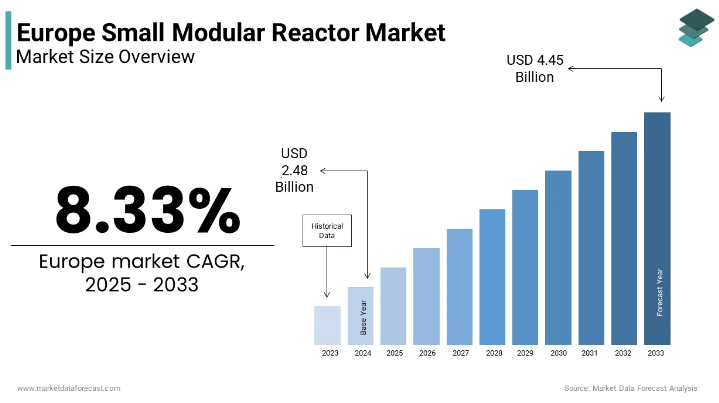
Europe is investing billions in Small Modular Reactors (SMRs) to power energy-hungry AI infrastructure. But this path deepens dependence on massive, centralised systems.

Europe SMR Market Growth 2023–2033

Europe’s projected SMR investment (2023–2033) - to power AI that may not need such scale.

Kiwacht-Edge is an alternative: high-value intelligence without high-energy cost.

By using efficient SLMs, we deliver sovereign AI that is green, affordable, and accessible - without building new reactors.

× Close

What is Kiwacht-Edge?

Trust in AI erodes when users don't know where their data goes.

With Kiwacht-Edge, your communications remain in your control. SLMs assist, but never learn from you.

This transparency builds trust which opaque, cloud-based LLMs cannot match.

× Close

What is KiWacht?

Your domain expertise is too valuable to train someone else’s model.

Why feed an impersonal foundry with your knowledge? Share what you know with your friends around a campfire.

× Close

Zero Data Footprint

Kiwacht-Edge embodies ephemeral intelligence: it helps in the moment, then forgets.

No persistent storage means no breach risk, no audit nightmares, no hidden data lakes.

In an age of surveillance, forgetting is a feature.

× Close

Human-in-the-Loop

Automation without oversight leads to error and erosion of accountability.

Kiwacht-Edge is designed as a collaborative tool, it suggests, summarises, routes, but never acts without human approval.

This ensures ethical alignment, contextual accuracy, and user sovereignty.

× Close

Workflow-Agnostic

Whether it's a Berlin tax office triaging citizen emails, a Lidl store monitoring oven alerts, or a creative agency managing client feedback - Kiwacht-Edge adapts.

Its workflow-agnostic architecture means you don't need separate AI tools for each channel.

One sovereign system. Infinite use cases.

× Close

Ethically Coherent

Most AI optimises for engagement, data extraction, or scale.

Kiwacht-Edge optimises for human dignity, data sovereignty, and European values.

We believe Europe can lead in AI not through scale, but through sovereignty and by building intelligence which is non-extractive, but incorporates user-defined rules.

× Close

Explore Our Principles

Click "more" on any of the cards above to see detailed explanations of our sovereign AI principles.

ℹ️